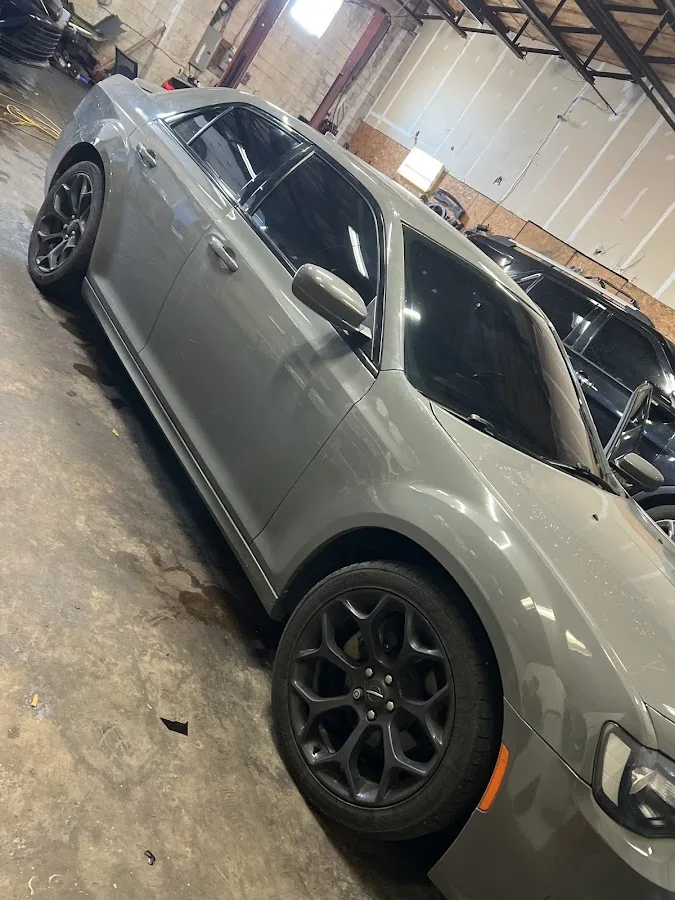
Factory-tinted glass makes added window film darker than the film’s label alone suggests. To estimate the finished window’s visible light transmission (VLT), multiply the glass’s starting VLT by the film’s VLT, using decimals. A window with 70% VLT glass and 50% VLT film comes out to about 35% combined VLT—not 50%.
Factory tint and applied film are different layers
Factory-darkened privacy glass is part of the window glass itself; aftermarket tint is a separate film applied to the glass surface. They are two light-reducing layers in the same viewing path. The film’s advertised VLT describes the film, while the finished window’s VLT reflects the glass and film together.
That distinction matters most when a vehicle already has dark rear windows. Choosing a film by its standalone percentage can make the final result substantially darker than expected. For instance, 50% film over clear glass would transmit more visible light than the same film over glass that already transmits only 70%.
Also avoid treating one window as a proxy for the whole vehicle. Front, rear, and side panes can have different starting transmission. A factory-darkened rear window does not tell you what the front door glass transmits, so a single visual impression cannot establish one baseline for every pane.
Estimate combined VLT by multiplying the two values
Convert both percentages to decimals, multiply them, and convert the product back to a percentage. For example, 70% becomes 0.70, and 50% becomes 0.50. The product, 0.35, corresponds to an estimated combined VLT of 35%. This gives a useful way to compare options before film is installed.
Here are several examples of how the same film rating can produce different combined estimates on different glass:
| Glass VLT | Film VLT | Estimated combined VLT |
|---|---|---|
| 70% | 50% | 35% |
| 80% | 50% | 40% |
| 60% | 70% | 42% |
The multiplication is straightforward, but compare like with like: use the VLT for the actual glass and the specific film under consideration. A label such as “50% film” is not a promise that the finished pane will transmit 50% of visible light. The table also shows why film selection should begin with the existing window, rather than with a shade name in isolation.
One film rating does not predict every window’s appearance
If the same film goes on two panes with different starting VLT, the calculated combined values will differ. Say a vehicle has one pane at 70% VLT and another at 80%. With 50% film, the estimates are 35% and 40%. The second pane is expected to pass more visible light, although the film choice is identical.
VLT answers a specific question: how much visible light passes through the glass-and-film combination. It is not a complete description of the window’s appearance or every aspect of film performance. Two products with similar VLT figures may still look different in color or reflectivity, and VLT alone does not describe those qualities. Compare those characteristics separately rather than trying to infer them from the transmission percentage.
In practical terms, a photo or a glance at another vehicle may help you describe a preferred look, but it cannot supply the measurement for your own glass. The pane’s starting value and the film’s own rating are the inputs that make the VLT estimate meaningful.
Check each pane before choosing added film
A pane-by-pane comparison turns the formula into a practical selection tool. Make a simple table for the windows you are considering, and use a separate row for each pane or pane group with a shared measurement.
- Identify the panes. List the windows you may tint instead of assigning one assumed factory VLT to the entire vehicle.
- Record the starting value. Use an available VLT reading for each pane; visual darkness is not a dependable substitute for a percentage.
- Compare candidate films. Multiply each glass value by each candidate film’s VLT. Keeping the arithmetic in the table makes it easier to see how a change in film affects one pane versus another.
- Check the installed combination. A tint-meter reading of the glass and film together can be used to check the estimate on the actual window.
Harrisburg drivers looking for a local window-tinting service can consider M&J Films - Harrisburg, Pennsylvania.
The useful comparison is the finished combination on each pane, not the film percentage considered by itself. Once those values are organized, you can compare film options against the level of visible light you want to retain and distinguish numerical transmission from the separate question of how the glass will look.